


Building a Digital Presence That Sells Without Selling
- Veronica Mathai

- Mar 5
- 4 min read
Social Media & Digital Content Management

Client Snapshot
Dominic Okafor had every credential a nonfiction author could want. A former journalist with bylines in three national publications, a decade of experience covering the intersection of technology and culture, and a debut book — a deeply reported exploration of algorithmic bias in everyday life — that his publisher genuinely believed had crossover potential. Smart, timely, and written with the kind of clarity that made a complicated subject feel urgent and accessible.
What Dominic didn't have was a social media presence worth speaking of. His accounts existed, but they were dormant in the way that busy, skeptical journalists' accounts often are — a few retweets, the occasional link drop, nothing that told a story or built a following. He was deeply ambivalent about social media on principle, which made the situation both understandable and urgent. His publisher had flagged platform as a gap during acquisitions and was watching to see whether it would be addressed before launch.
With five months until publication, Dominic needed a digital content strategy that could build genuine audience without compromising the intellectual integrity he'd spent his career protecting.
The Challenge
Dominic's resistance to social media wasn't performative — it was principled. He had reported on the ways algorithmic platforms manipulate behavior and attention, and he was uncomfortable participating in the very systems his book critiqued. Any strategy that asked him to chase engagement metrics, post performatively, or adopt the hollow vocabulary of personal branding was going to fail, and not just because he'd resist it. It would have been the wrong strategy for his audience anyway.
His readers — the people most likely to buy, recommend, and champion his book — were not passive scrollers. They were curious, skeptical, intellectually engaged people who would see through content that felt manufactured. What they would respond to was exactly what Dominic was already doing in private: thinking carefully about complicated things and articulating them with precision and wit.
The challenge, then, wasn't to turn Dominic into a content creator. It was to create a framework that could translate who he already was into a consistent, sustainable digital presence — one that attracted the right readers, satisfied his publisher's platform expectations, and didn't require him to become someone he wasn't.
My Approach & Process
The first conversation I had with Dominic wasn't about social media at all. It was about his ideas. I asked him what he was thinking about that hadn't made it into the book. What questions his reporting had left open. What he was reading, arguing about, noticing. Within an hour, I had more than enough raw material for months of content — and more importantly, I understood how his mind worked and what his natural voice sounded like when he wasn't performing for an audience.
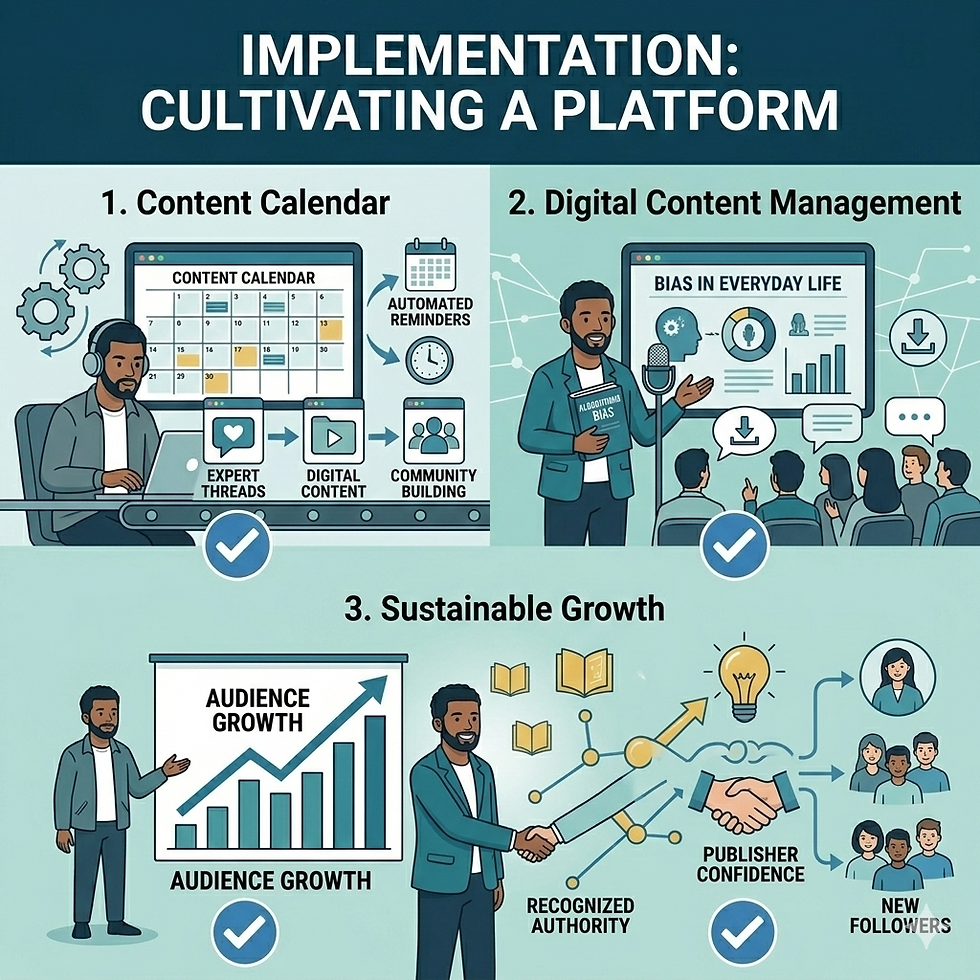
That became the foundation of everything. Rather than building a content calendar around trends or platform best practices, I built it around Dominic's existing intellectual rhythms. He thought in long-form, so we created a newsletter as the anchor of his digital presence — a biweekly dispatch that gave him room to develop an idea fully, without the compression that social media demands. Every other channel flowed from that. LinkedIn became the home for excerpted thinking and industry conversation. Twitter/X was used sparingly and strategically — links, observations, the occasional thread when a topic genuinely warranted it. We never posted for the sake of posting.
I handled content planning, scheduling, and the bulk of the channel management, working from raw material Dominic provided in whatever form was easiest for him — voice memos, rough paragraphs, links with a sentence of annotation. My role was to shape, adapt, and distribute. His role was to think, which he was already doing.
We also built a pre-launch content arc that aligned with the book's themes without being promotional. In the two months before publication, Dominic's newsletter and social channels told a coherent story — not "my book is coming," but "here is the conversation my book is entering." By the time the book released, his audience already felt invested in the ideas. The launch wasn't an interruption of his content. It was a natural continuation of it.
Tools & Strategies Used
Audience and voice analysis through in-depth intake conversations
Newsletter-anchored content ecosystem with platform-specific adaptations
Editorial content calendar built around intellectual themes, not trends
Raw material intake system accommodating multiple formats (voice, notes, links)
Pre-launch thematic content arc aligned with book's core ideas
Scheduling and channel management with weekly reporting on reach and engagement
Platform-specific tone and format guidelines for LinkedIn and Twitter/X

The Results
Over five months, Dominic's newsletter grew from zero to just under 2,400 subscribers — an audience he owned outright, independent of any algorithm. His LinkedIn following grew by 340%, driven primarily by long-form posts that consistently outperformed industry benchmarks for engagement in his category. Two of his newsletter issues were shared widely enough to drive traffic spikes to his publisher's pre-order page, and one was republished in an industry publication, extending his reach to an entirely new readership.
By launch week, Dominic had an engaged digital audience that had been thinking about his book's ideas for months. His publisher noted the platform growth in internal communications and referenced it when pitching foreign rights. The book debuted strongly in its category and was picked up for three additional media appearances that originated directly from newsletter readers who worked in journalism and broadcasting.
Dominic, for his part, had found a way to participate in digital culture on his own terms — something he hadn't believed was possible when we started.
Reflection
"I came in deeply skeptical that any of this could be done without compromising what I care about. What surprised me was that the strategy was built around protecting that, not overriding it. I wasn't asked to become a different kind of writer. I was just asked to let more people see the one I already was."
— Dominic O., Journalist & Nonfiction Author
All client details have been fictionalized to protect confidentiality. This case study reflects the scope, approach, and outcomes representative of this type of engagement.


Comments