


From Chaos to Clarity: Building an Onboarding System That Scaled
- Veronica Mathai

- Mar 5
- 4 min read
Updated: Mar 6
Client/Customer Onboarding & Communication

Client Snapshot
Renata Voss had built her literary agency from the ground up over a decade. What started as a one-woman operation representing a handful of debut fiction writers had grown into a thriving boutique agency with fourteen active clients. The agency had two junior agents, and a roster that now included nonfiction, memoir, and young adult titles alongside her original literary fiction base.
Growth, by most measures, looked good on Renata. But behind the scenes, it was quietly unraveling her.
The same informal, relationship-driven approach that had made her exceptional with a small client list was buckling under the weight of a larger one. New clients were being onboarded through a patchwork of email threads, phone calls, and hand-delivered documents.
Expectations around communication timelines were unspoken and inconsistently managed. Junior agents were improvising processes that Renata hadn't formalized because, until recently, she hadn't needed to. Authors, particularly debut authors who had no prior experience with the publishing industry were arriving anxious, confused, and in need of far more hand-holding than anyone had bandwidth to provide.
By the time Renata reached out, she was spending an estimated eight to ten hours a week answering questions that a well-designed onboarding system could have answered in advance.
The Challenge
Renata's commitment to her clients was evident in everything she did. The problem was that her systems hadn't kept pace with her growth. What worked beautifully for three clients didn't work for fourteen, and it certainly wasn't going to work for twenty.
There were several specific pressure points. First, new clients had no single source of truth — no document, portal, or guide that told them what to expect from the agency relationship, how communication would work, or what the submission and negotiation process actually looked like from the inside. Second, the agency had no standardized communication cadence, which meant some clients felt over-serviced while others quietly worried they'd been forgotten. Third, onboarding new clients was entirely dependent on Renata herself, creating a bottleneck that her junior agents couldn't relieve because the process lived only in her head.
The ask was clear: build a scalable onboarding and communication system that felt as personal and warm as Renata's one-on-one approach without requiring her to be the one delivering it every time.
My Approach & Process
I started with a listening audit. Before designing anything, I spent two weeks conducting informal interviews with several of Renata's current clients, with her permission, asking them to describe their onboarding experience, what questions they'd had that went unanswered, and what they wished they'd known earlier. I also sat down (zoom call) with her junior agents to understand where the communication gaps were most acutely felt from the inside.
What I found was consistent: clients didn't need more contact, they needed more context.
The anxiety most of them experienced in the early months of the agency relationship wasn't about distrust, it was about unfamiliarity with a process that insiders took for granted. The publishing industry moves slowly and with very little transparency, and most debut authors had no frame of reference for what "normal" looked like. Simply naming that, and building materials that normalized the timeline and process, would address the majority of the friction.
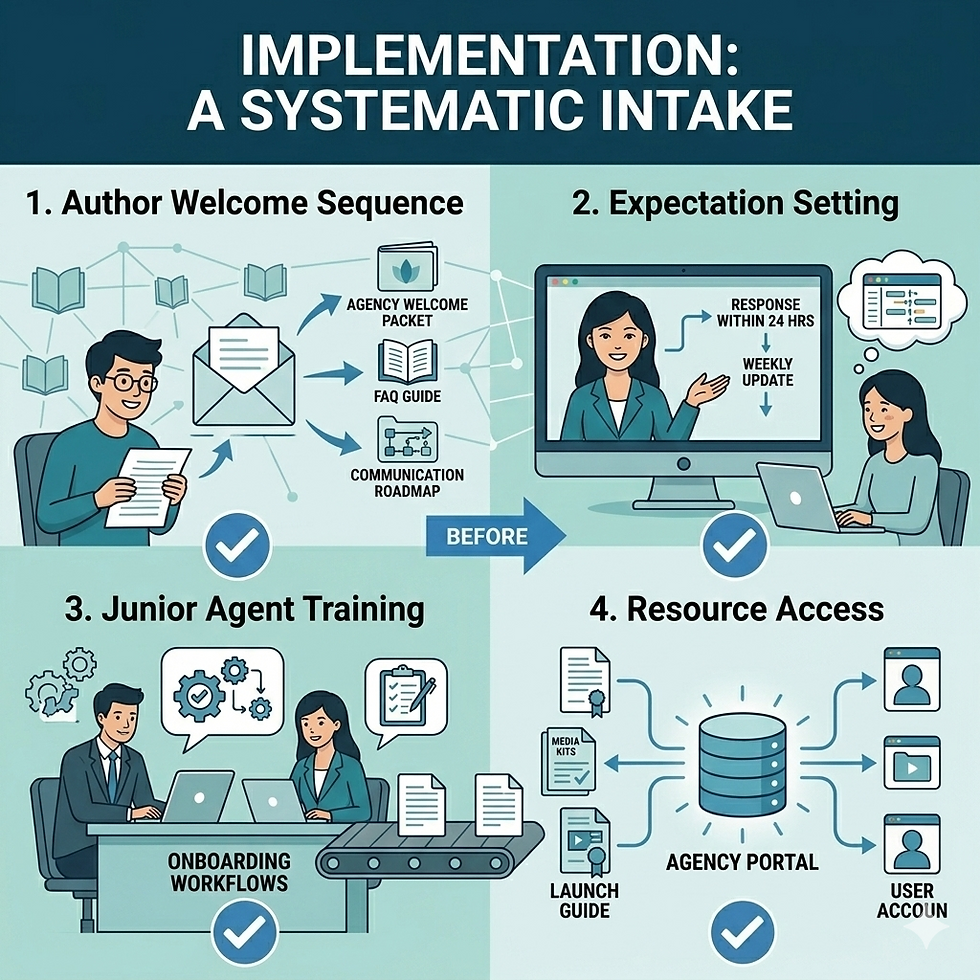
From that foundation, I developed a three-stage onboarding system. The first stage covered the initial welcome, a sequence of communications that went out in the first 48 hours after signing, including a warm welcome letter written in Renata's voice, a comprehensive client guide covering everything from submission timelines to communication expectations, and a short FAQ document built directly from the questions her existing clients had asked most frequently.
The second stage covered the first 30 days, a structured check-in cadence that gave clients predictable touchpoints without requiring Renata to manage each one personally. The third stage was an evergreen communication framework: a quarterly update template, a milestone communication guide for key moments like offer calls and deal announcements, and a set of email templates her junior agents could use confidently and consistently.
Throughout, I worked carefully to preserve Renata's voice. A scalable system only works if it still sounds like the person it represents. Every document, template, and communication was written to feel personal, considered, and distinctly hers.
Tools & Strategies Used
Client listening audit and internal workflow interviews
Three-stage onboarding system: welcome, 30-day, and evergreen frameworks
Comprehensive client welcome guide and industry-contextualized FAQ
Milestone communication templates for key publishing moments
Quarterly update template for ongoing client relationship management
Junior agent communication protocols and delegation-ready email templates
Voice and tone guide to ensure consistency across all team communications

The Results
Within sixty days of implementing the new system, Renata's weekly time spent on reactive client communication dropped from eight to ten hours to under two. New clients were arriving to their first check-in calls already oriented — familiar with the process, clear on expectations, and focused on strategy rather than logistics. Her junior agents, equipped with delegation-ready templates and clear protocols, were able to manage a meaningful portion of client communication independently for the first time.
Perhaps most tellingly, the onboarding system became a selling point in itself. Renata began sharing the client guide during the offer stage before a prospective client had even signed and reported that it consistently accelerated decision-making. Authors who might have shopped offers longer signed faster, in part because the guide demonstrated, concretely, what the agency relationship would actually look like.
Three months after launch, Renata took on two new clients without any corresponding increase in her administrative workload. The system scaled exactly as designed.
Reflection
"I kept telling myself I'd formalize things once things slowed down. But things don't slow down — they just get more complicated. What I didn't expect was how much the system would do for my clients, not just for me. Authors would tell me they felt taken care of before we'd even had our second call. That's when I realized good communication infrastructure isn't just an operational fix. It's part of the service."
— Renata V., Literary Agent & Agency Founder


Comments